Linga – Yoni
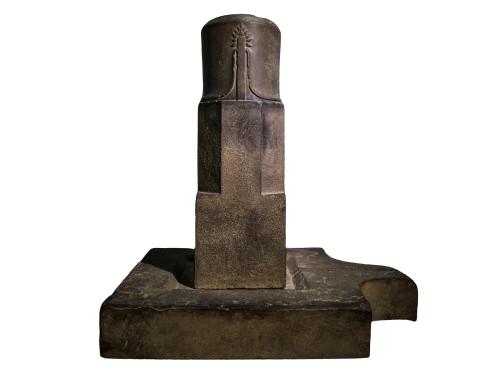
Dating: 7th–8th century CE
Provenance: Tra Kieu, Quang Nam Province
Inventory No.: BTC 104
Material: Sandstone
The worship of the Linga and Yoni originated among the ancient peoples of the Indus Valley. “Their faith was interwoven with myths of the Mother Goddess and the veneration of female generative power, regarding the Yoni as the ultimate source of all creation. Beside the Mother Goddess stood a male deity, represented by a phallic stone pillar” (according to Will Durant). In Hinduism, the god Shiva first manifested as a boundless pillar of fire in phallic form. Over time, the Linga and Yoni became stylized symbols for worshipping Shiva—the Linga representing the masculine aspect and the Yoni representing the feminine energy (Shakti), portraying Shiva as an androgynous deity. The combination of the Linga resting upon the Yoni signifies the supreme creative power of Shiva.
Linga sculptures in Champa exhibit various typologies and forms. In this specific masterpiece, the Linga is divided into three sections, symbolizing the Hindu Triad (Trimurti): the upper cylindrical section represents Shiva, the god of destruction; the middle octagonal section represents Vishnu, the god of preservation; and the lower square base represents Brahma, the god of creation. This tripartite structure represents one of the most classic and widely recognized Linga forms in Champa art.
Image Gallery